

A second aerial view
Use the Left and Right arrow keys, Home or End to browse. Press Space to pause or resume automatic photographs.
About the event
Teams develop a physical civil infrastructure solution for the damaged road-dike and river corridor in Cupang, Arayat, Pampanga.
The Top 10 teams receive mentoring to refine their designs. At the Grand Finals on March 5, 2027, finalists present their proposals to professional jurors and exhibit their models.
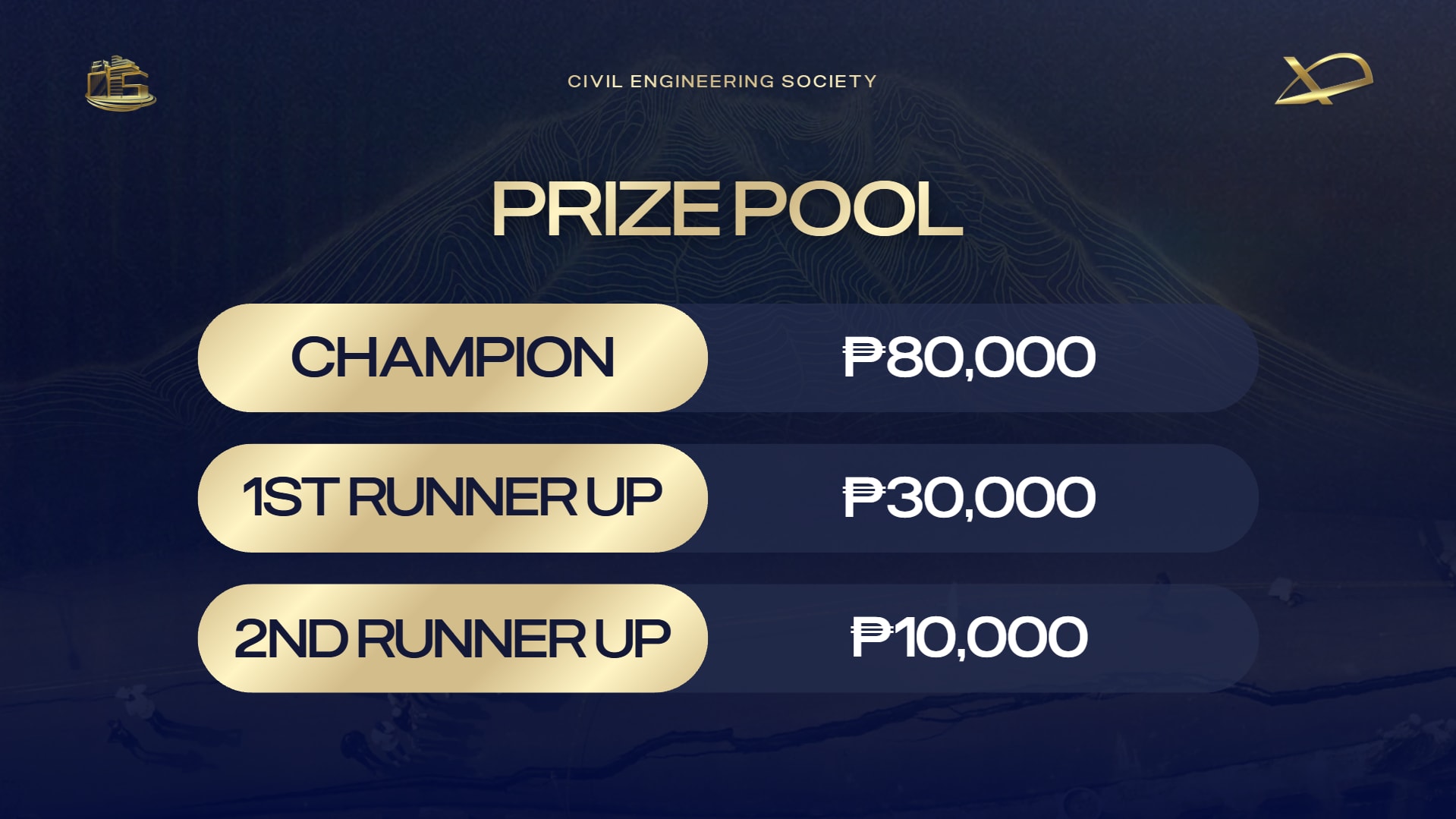
Competition primer

De La Salle University — CIVEX: National Infrastructure Challenge. Civil Engineering Society. Invitational Primer.
Who can join
Open to undergraduate civil engineering students from all universities and colleges across the Philippines. Teams must represent the same school or campus.
Team composition
- 3 to 5 students from the same school or campus
- The designated team leader is responsible for registration
- A faculty adviser is recommended, but not required
Registration fees Per member
College teams
- Private colleges
- PHP 250
- State universities and colleges
- PHP 200
These rates apply only to the Infrastructure Challenge.
Submissions & judging
Preliminary round
Preliminary concept board
Submit a one-page concept board in A3 landscape format as a PDF.
The preliminary round is an online submission, with no live presentation or defense.
- Problem diagnosis
Distinguish observed damage from possible engineering mechanisms.
- Proposed infrastructure concept
Show a plan, cross-section, sketch, system diagram or conceptual rendering.
- Technical rationale
Explain how the concept addresses the relevant site risks.
- Feasibility
Identify major materials, construction approach, preliminary cost range and implementation considerations.
- Resilience and community impact
Explain protection, connectivity and how the concept avoids transferring risk elsewhere.
Top 10
Shortlisted teams refine their proposals during mentorship, covering:
- Design development
- Calculations
- Cost estimates
- Constructability review
Grand Finals
- Technical report
- Professional presentation and live defense
- Physical scale model
Evaluation criteria
- Problem diagnosis: identify the key engineering problems and distinguish observed conditions from possible causes.
- Technical concept: explain how the proposed physical infrastructure addresses the site’s hydraulic, geotechnical and drainage risks.
- Feasibility and constructability: demonstrate a realistic construction approach, materials and preliminary cost estimates.
- Resilience: account for remaining flood risk and long-term environmental and technical sustainability.
- Community impact: protect people, livelihoods and connectivity without creating new risks for adjacent communities or river systems.
Timeline
After registration and case release, teams submit a preliminary concept board online. The Top 10 advance to mentorship, final submissions and a live Grand Finals defense at DLSU.
Registration opens
Review the competition primer, form your team and prepare your registration documents.
Registration closes
Complete your team’s registration and upload the registration documents by 11:59 PM Philippine time.
Onboarding and case release
Attend the competition briefing and receive the case prompt, site data and engineering constraints.
Preliminary concept board due
Submit the one-page A3 landscape Infrastructure Concept Board as a PDF. No live presentation is required for this round.
Top 10 announcement
The shortlisted teams advance to mentorship and technical refinement.
Mentorship and technical refinement
Develop the design, calculations, cost estimates and constructability with professional guidance. Check-ins cover structural model approval on February 6, 2027 and cost realism on February 19, 2027.
Final report and slides due
Submit the final technical report and presentation slide deck.
Grand Finals
Present and defend the proposal before professional jurors and exhibit the physical scale model at De La Salle University–Manila.
Cupang, Pampanga: The river-dike challenge
Barangay Cupang lies beside a meandering reach of the Pampanga River in Arayat, Pampanga, within the Pampanga River Basin. The levee’s performance matters to public safety, connectivity, the surrounding community and floodplain agriculture.
In December 2025, progressive deformation and damage were documented along a section of the levee near a river bend.
Site interview
2:37Watch the on-site interview for context on the riverbank works in Cupang, Pampanga.
Design considerations
- High river stages and flood exposure
- Possible bank and bed changes
- Embankment and foundation behavior
- Surface and subsurface drainage
- Risks to people and assets
Students investigate these linked processes and propose independent, defensible approaches rather than adopt a predetermined intervention.
What your proposal should address
Develop an evidence-based, practical and sustainable flood-risk management strategy that relieves stress on the Cupang dike and protects surrounding communities and infrastructure.
Reduce stress on the dike
Identify the causes of deterioration and instability, then address hydraulic, geotechnical, scour, seepage and drainage stresses that could lead to further damage or failure.
Reduce residual flood risk
Address risks that remain despite existing flood protection, including overtopping or failure, prolonged inundation and inadequate local drainage. Consider people, property, infrastructure, livelihoods and community connectivity.
Consider the appropriate combination of measures
Evaluate grey infrastructure, green infrastructure and hybrid green-grey solutions. Land-use planning, floodplain management and non-structural measures may support the proposal; its primary solution must be physical civil infrastructure.
Assess expected effectiveness, technical feasibility, cost, environmental and social effects, long-term sustainability, and effects on adjacent communities and river systems.


Use the Left and Right arrow keys, Home or End to browse. Press Space to pause or resume automatic photographs.
FAQs
Can students from different universities form one team?
No. All team members must come from the same university or campus.
Can a team have fewer than 3 or more than 5 members?
No. Each team must consist of 3 to 5 student members.
Is a faculty adviser required?
No. Having a faculty adviser is recommended but not required.
Can one student join more than one team?
No. Each student may only be registered under one team.
Is the Preliminary Round conducted online?
The Preliminary Round is submission-based. Teams will submit their required output online and will not be required to attend a live presentation.
Is there a live presentation during the Preliminary Round?
No. There will be no live presentation or defense during the Preliminary Round.
What is the format of the Preliminary Round submission?
Teams must submit a One-Page Infrastructure Concept Board in A3 landscape format as a PDF.
- Problem diagnosis
- Proposed infrastructure concept
- Technical rationale
- Feasibility and constructability
- Resilience and community impact
The board should clearly present the items above. Visuals such as plans, cross-sections, engineering sketches, system diagrams, or conceptual renderings may be used to communicate the proposal.
Are teams required to use only the data provided by CIVEX?
No. Teams may use additional information and datasets from credible external sources.
All external sources, assumptions, and data used must be properly cited and clearly documented.
Can teams propose a completely different infrastructure solution from the existing dike?
Yes. Teams are not required to retain or replicate the existing structural system.
Participants are encouraged to determine the most appropriate infrastructure solution based on their analysis of the site, available data, risks, and engineering constraints.
Can non-structural solutions be the main proposal?
No. The team’s primary proposal must be a physical civil infrastructure project.
Non-structural measures such as monitoring systems, policies, early-warning systems, land-use strategies, or community programs may be included only as supporting components.
Will additional technical data be provided to finalists?
Yes. Teams advancing to the finalist stage will receive additional technical information to support the further development and refinement of their proposals.
Are engineering software and digital tools allowed?
Yes. Teams may use engineering software, modeling programs, GIS tools, CAD software, and other relevant digital tools.
However, the use of specialized software is not required.
Is there a registration fee?
Yes. The registration fee is ₱200 per participant for State Universities and Colleges (SUCs) and ₱250 per participant for Private Higher Education Institutions (HEIs).
Payment instructions will be provided through the official CIVEX registration guidelines. Payment is non-refundable.
What happens if our registration documents are incomplete?
Teams with incomplete requirements will be notified and may be given a period to complete or correct their submission before the registration deadline.
Teams that fail to submit the complete required documents within the prescribed period may not be officially confirmed as participants.
How will the Top 10 Finalists be selected?
Preliminary submissions will undergo technical evaluation by a panel composed of professionals from DPWH, Megawide, and other designated engineering professionals or academic representatives.
Teams will be evaluated based on the official Preliminary Round judging criteria, including the strength of their problem diagnosis, technical concept, feasibility, resilience, and community impact.
The Top 10 teams with the strongest overall submissions will advance to the next stage of the competition.
Will mentors design or develop the project for the finalists?
No. All competition outputs must remain student-led.
Mentors may provide technical comments, recommendations, questions, and professional insights to help teams refine their ideas, but they will not design the project or prepare competition deliverables on behalf of the participants.
All teams are given the same limited time, which they can use however they want to consult with their mentors.
Are flights for the Grand Finals shouldered by the participants?
For qualified finalists coming from outside Metro Manila, one selected team’s airfare or flight expenses for the Grand Finals will be shouldered by CIVEX, subject to the official travel guidelines and arrangements provided to finalists.
Other travel-related expenses will be subject to the final participant guidelines.
Can teams change members after registration?
Member changes may only be allowed for valid and exceptional circumstances and must receive prior approval from the CIVEX Organizing Committee.
Once the finalist stage begins, team composition is expected to remain final except in cases approved by the organizers.
Who can we contact for clarifications?
For questions regarding registration, eligibility, competition mechanics, or technical requirements, participants may contact the official CIVEX Project Heads through the contact details provided in the CIVEX information kit and official social media channels.
Participants are encouraged to check the official FAQ and competition announcements first before sending inquiries, as updates and common clarifications will also be posted there.
Where is the venue?
The Grand Finals will take place at De La Salle University–Manila. CES will announce the room, start time and campus entry instructions.
Can I watch the proposal defense?
Registration details for attending the proposal defense will be announced by CES.